The first ping from Tonga (1997)
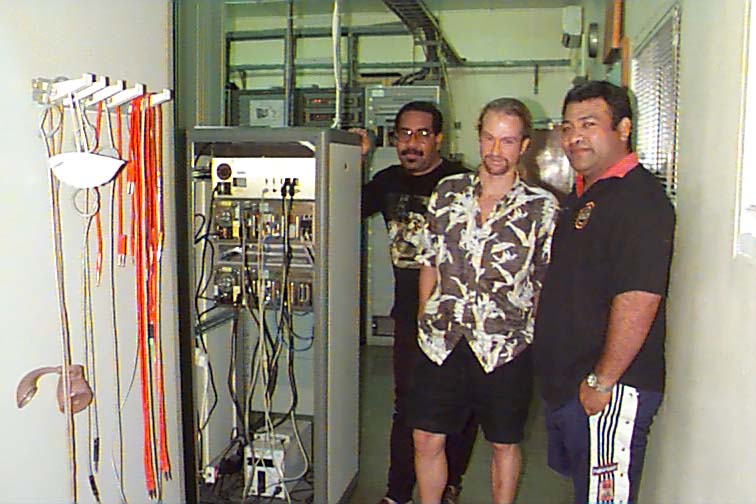
In January 1997, we sent a ping from the Kingdom of Tonga and got a reply. The Kingdom finally had a permanent connection to the internet, 64 kb/s over a satellite link. Getting there had involved an assortment of secondhand hardware, improvised networks, a Crown Prince, and some unauthorized climbing on rooftops.
When I began spending time in the Kingdom of Tonga in the early 90s, Cable & Wireless was the monopoly telco, international calls costing US$3 per minute to anywhere outside of Tonga. Spendy even for tourists, beyond exorbitant for locals. You'd queue, and when your turn came, sit in a little booth and the operator would connect you.
TESS, the Tongan Electronic Secretary Service
The telco monopoly had rotten infrastructure, an ancient troposcatter system unreliably serving the outer island of Vava'u, where my friend Commander Goldstern lived. He and other people with businesses in Vava'u were sick of the poor communication, so in 1995 I bought a couple of Telebit Trailblazer modems at some surplus place in Silicon Valley and flew up to Vava'u with one and a server running an early RedHat crammed in Goldstern's Lake Buccaneer.
People could then dial into our fax server in Vava'u and the Trailblazers would get the fax data down to Tongatapu. At 19.2 kb/s, but reliably. My SGI Indigo in Sausalito would dial out to Tonga hourly using some sort of scammy, cheap, long-distance expired card service, and retrieve the fax data from our server in Tongatapu. Once in California, the faxes would be forwarded to their destinations.
Why a "secretary service"? Well... it was not legal to run a communication company without a license.
UUCP email
Of course, these regular dialup connections also allowed me to transfer UUCP email. I set up a public email cafe in Tongatapu using a large pile of dumb NCD X-terminals, sourced at magnificent RA Enterprises near the San Jose airport. Lines for the email cafe formed around the block, as the price charged for an hour of email, one pa'anga, was far less than what Cable & Wireless charged for a minute of telephony.
By 1995, I had been delegated the .TO ccTLD by Jon Postel, as that was appropriate for email from Tonga. I asked, he delegated it. And by April 1996 we had DNS running, and a couple of machines online in the Consulate in SF.
The first ping
Crown Prince Tupouto'a ("HRH") and I had become friends. HRH traveled extensively, always staying at the finest hotels, and was well aware of the potential of the internet.
The manager of Cable & Wireless in the Kingdom of Tonga, Jon Morris, said nobody in Tonga would ever want the internet. But nevertheless, at HRH's urging, Jon relented and awarded me a meagre contract to bring in the necessary equipment to attach to their C-band earthstation for an internet link. So my friend Eric Lyons and I hauled in from California various crates of servers running RedHat 3.0.3 and a Cisco 2501 router. I recall it started on a single 64 kb/s space segment. Gratuitously, it was mango season, and we stuffed ourselves with ripe hot mangoes as they dropped from a magnificent tree outside the earthstation.
The photo at the head of this post is the Cable & Wireless machine room in January 1997 shortly after our first ping, the first IP packet sent from the Kingdom over the C-band internet connection, a moment of jubilation. Everything before that, including our fax and UUCP systems, ran through modems over analog telephone circuits. The Kingdom had never previously had an IP connection.
And it didn't take long for others to notice.
Spread spectrum link
Of course, HRH wanted the internet in his bedroom, as one does.
The tallest building in town was the four-story Reserve Bank building. I bought a couple of early PairGain Megabit Modem 768 HDSL modems and over semi-rotten copper twisted pair in the ground managed to get 768 kb/s symmetric from the Cable & Wireless earthstation to the Reserve Bank building.
With the help of a small commando team from Tonga Defense, one afternoon we installed a small parabolic antenna on the roof of the bank building. And with a pair of unamplified Digital Wireless Corporation WIT-2400 frequency-hopping radio modems managed to establish a surprisingly reliable link about six kilometers from the roof of the bank building to HRH's Italianate villa. We were amazed that 100 milliwatts would work over six kilometers, even with line of sight. Why use the military for the antenna installation? Well, that was easier than getting permission from the governor of the Reserve Bank, who the next morning loudly objected to what he saw as an ugly antenna.
As an aside, I almost fell 4 stories off the roof of the Reserve Bank when I touched the live JOCV HF antenna. I still have scars on my ass from where the bolts attaching the metal roofing stopped my slide.
The commercialization of the .TO domain
Tonga had gone from US$3 per minute operator-connected international calls to a permanent internet link in only a few years. The improvised fax and UUCP systems were obsolete almost immediately, which was exactly the outcome we'd been trying to achieve.
We'd managed to connect Tonga to the internet. Next, we discovered that its DNS namespace might be worth rather more than the satellite connection itself. But that's another story, one that is already well documented:
Contemporary coverage (1997)
- Steve G. Steinberg, "Domain Names, Tonga and Two Guys Named Eric" , Los Angeles Times, June 9, 1997.
- Kaitlin Quistgaard, "Tonga's Big Domain-Name Sale" , Wired, June 12, 1997.
- Zachary Coile, "The Tonga Connection" , San Francisco Examiner, June 29, 1997.